The Complete Guide to Automating Pet Food & Treat Packaging

Automating pet food and treat packaging means replacing manual or semi-manual filling and sealing operations with machinery capable of running 20–60+ bags per minute — at consistent fill weights, seal integrity, and line speeds that manual labor can’t sustain.

This guide covers everything operations and engineering teams at pet food manufacturers need in order to evaluate, select, and implement packaging automation. That includes format options, machine configurations, food safety requirements, ROI benchmarks, and how to know when the time is right.

Note: The labor cost figures and operational benchmarks used throughout this guide reflect current U.S. manufacturing industry standards. Actual costs will vary based on your location, workforce, production environment, and operational setup. Use them as a directional reference, not a guarantee.

Why Pet Food Packaging Is Moving Toward Automation

The U.S. pet food and treats market has grown substantially over the past decade, driven by the push toward premium products, America’s love of pets, and the expansion of specialty formats (freeze-dried raw, soft chews, toppers, meal mixers, and functional treats).* This growth is putting pressure on packaging lines that were designed for simpler, lower-SKU production.

Three forces are accelerating the adoption of automation across the segment:

Throughput
constraints


Retailers and e-commerce fulfillment centers keep tightening order fill rates and delivery windows. A manual line running 8–12 bags per minute can’t keep pace with a brand growing 30% a year. Simplex premade pouch machines run 20–60 bpm, duplex and quadruplex far higher — capacity that scales without added headcount.

Labor availability & consistency


Manual packaging depends on trained people repeating the same motions at a steady pace. Turnover, shortages, and injury risk make that dependency expensive. Automation absorbs the repetitive work and frees operators for quality control, line supervision, and changeover.

More products &
more formats


Global pet food launches rose 21% from 2020 to 2024, and nearly half of launches arrive in stand-up pouches: resealable zippers, flat bottoms, single-serve sizing, spouted. These formats align with what specialty retailers and direct-to-consumer (DTC) brands need to stand out. Running a 2 oz. pouch, a 1 lb. resealable, and a 5 lb. flat-bottom bag on one line requires fast, tool-free changeover.

*The U.S. pet food market reached $43.45 billion in 2024 and is projected to grow at a 4.3% through 2030, with the snacks and treats segment specifically growing at a 4.7% over the same period, according to Grand View Research. Premiumization is a major driver of that growth. Premium products now make up about 30% of dog food volume and 10–15% of cat food volume (OC&C, via Petfood Industry). Specialty formats are expanding even faster than the category: dog food toppers and mixers have grown 129% since 2018, and cat food toppers and mixers 138%, according to APPA data, while freeze-dried and jerky treats are projected to grow at an 8.5% CAGR through 2031 (Mordor Intelligence).

Packaging Format Comparison:
Premade Pouch vs. VFFS vs. Flow Wrap vs. Stick Pack

Choosing the right packaging format is the first decision, and it affects every equipment decision downstream.

Premade Pouch (Rotary Fill-and-Seal)

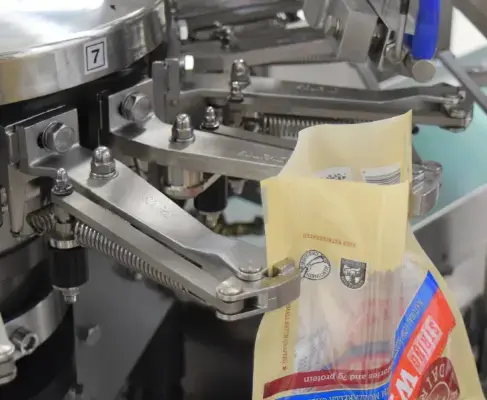
A premade pouch is a pre-formed bag that arrives at the packaging machine already manufactured. The machine opens each pouch, fills it with product, and heat-seals the top. Premade pouch machines run in a rotary configuration, with pouches moving through a series of stations: opening, filling, sealing, and discharge.

Best for: Dry kibble, treats (biscuits, soft chews, freeze-dried), toppers, meal mixers, powders

Pouch styles supported: Stand-up (doy-style/Doypack – a flexible packaging format with a gusseted bottom that allows the filled bag to stand upright on a shelf), flat-bottom (box-pouch), spouted, quad-seal, pillow — any pouch style the converter supplies pre-formed

Throughput: 15–20 bags per minute at entry-level; 40–60 on the flagship 8-station design (Simplex); higher on multi-lane configurations

Shelf appearance: Premium — consistent, ready for custom branding, retail-ready

Changeover: Fast, tool-free format changes; pouch width and depth are adjustable without specialized tooling

Capital cost: A larger footprint, greater capital investment, and higher price per impression, justified by premium presentation and format flexibility

Explore Premade Pouch For Petfood

Which Packaging Format Is Right For Your Product?
A Comparison Guide

Criteria
Criteria Premade Pouch VFFS Flow Wrap Stick Pack
Premium shelf presentation ✓ ✓ ✓ ✓
Format flexibility (bag styles) ✓ ✓ ✓
Throughput ceiling ✓ ✓ ✓ ✓
Fast changeover ✓ ✓ ✓ ✓
Best for dry treats ✓ ✓ ✓
Best for individually wrapped items ✓
Best for powders/supplements ✓ ✓ ✓

Read Premade Pouches vs. VFFS for Pet Food:


Learn More

PRODUCT-TYPE MATRIX: MATCHING FORMATS TO PET FOOD APPLICATIONS

Not every packaging format works for every product. This matrix maps common pet food and treat product types to recommended packaging formats.

Machine Configurations: Simplex, Duplex & Quadruplex

Once you’ve selected a format, the next decision is machine configuration — specifically, how many filling lanes the machine operates simultaneously. For premade pouch machines: Simplex (single-lane), duplex (2-lane), and quadruplex (4-lane).

Simplex

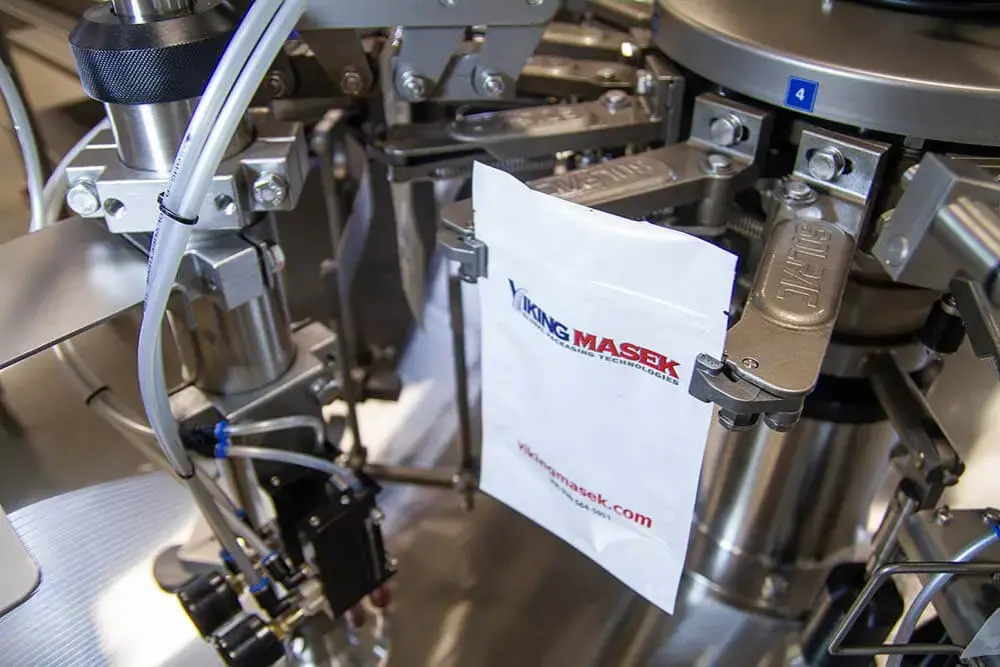
A Simplex premade pouch machine operates a single rotary turret, processing 1 pouch at a time through the open-fill-seal cycle.

  • Throughput: Entry-level machines run 15–20 bags per minute; flagship 8-station design runs 40–60 bags per minute (Simplex); higher on multi-lane configurations
  • Best for: Operations producing up to ~3 million bags annually; brands with multiple SKUs that require frequent changeover; first-time automation buyers
  • Footprint: Compact; typically able to integrate into existing lines with minimal infrastructure changes
  • Investment: Entry-level automation; lowest capital cost in the premade pouch family
Simplex

Duplex

A duplex configuration runs 2 parallel lanes simultaneously, effectively doubling throughput versus a Simplex.

  • Throughput: 70–90 bags per minute (combined)
  • Best for: Mid-volume operations; brands scaling up to meet retailer demand; operations in which 2 SKUs run simultaneously
  • Footprint: Larger than Simplex; typically requires a line redesign or dedicated packaging cell
  • Investment: Moderate; a step up that’s justified when your Simplex machine can’t keep up with your growth
Duplex

Quadruplex

A quadruplex runs 4 parallel lanes, delivering maximum throughput from a single machine.

  • Throughput: 140–180 bags per minute (combined)
  • Best for: High-volume, low-SKU-count operations; co-manufacturers running large production runs; operations in which cost per bag is the primary consideration
  • Footprint: Significant; requires dedicated floor space and integration with material handling
  • Investment: Highest in the premade pouch family; the economics make sense at high production volumes
Quadruplex

Which is Right?
Configuration Decision Framework

Consideration
Consideration Simplex Duplex Quadruplex
Annual bags produced <3M 3M–10M 10M+
SKU count High (6+) Moderate (3–6) Low (1–3)
Budget Entry-level Mid-range Premium
Changeover frequency Daily Weekly Monthly or less
Floor space available Limited Moderate Ample

Read Simplex vs. Duplex vs. Quadruplex Premade Pouch Machines: Right-Sizing Your Line


Learn More

Automation Readiness: When to Automate & How to Prepare

The right time to automate is before a throughput, labor, or quality problem becomes a crisis. Here are the clearest signals that a pet food manufacturer is ready for automation:

What to Prepare Before Automation

Know your product

Bulk density, particle size, flow characteristics, and any tendency to bridge or clump determine filler type (auger, volumetric cup, multihead scale) and affect machine selection.

Nail down your pouch specifications

Work with your film converter before you finalize machine selection. Dimensions, material construction, zipper type, and spout fitment all affect machine compatibility.

Understand utility need

Premade pouch machines require compressed air, electrical service, and, in some food environments, steam or hot water for cleaning cycles.

Map the line integration

Where does product come from upstream (bulk bins, hoppers, conveyors), and where does the filled bag go downstream (checkweigher, metal detector, cartoner, case packer)? Plan integration before machine selection.

Typical Implementation Timeline

Projects are managed through a five-phase project management lifecycle, with weekly meetings between the VM project manager and the customer.

Sanitation & Food Safety Requirements for Pet Food Packaging Equipment

Pet food packaging equipment must meet rigorous sanitation standards, not only for the safety of the animals consuming the product but for compliance under the FDA's Food Safety Modernization Act (FSMA) and, for larger operations, USDA oversight requirements.

FSMA & Pet Food

FSMA’s Preventive Controls for Animal Food rule (21 CFR Part 507) requires manufacturers to implement hazard analysis and risk-based preventive controls, including controls around packaging equipment that contacts or handles food. This means packaging machinery has to be designed to support cleaning and sanitation protocols that prevent contamination.

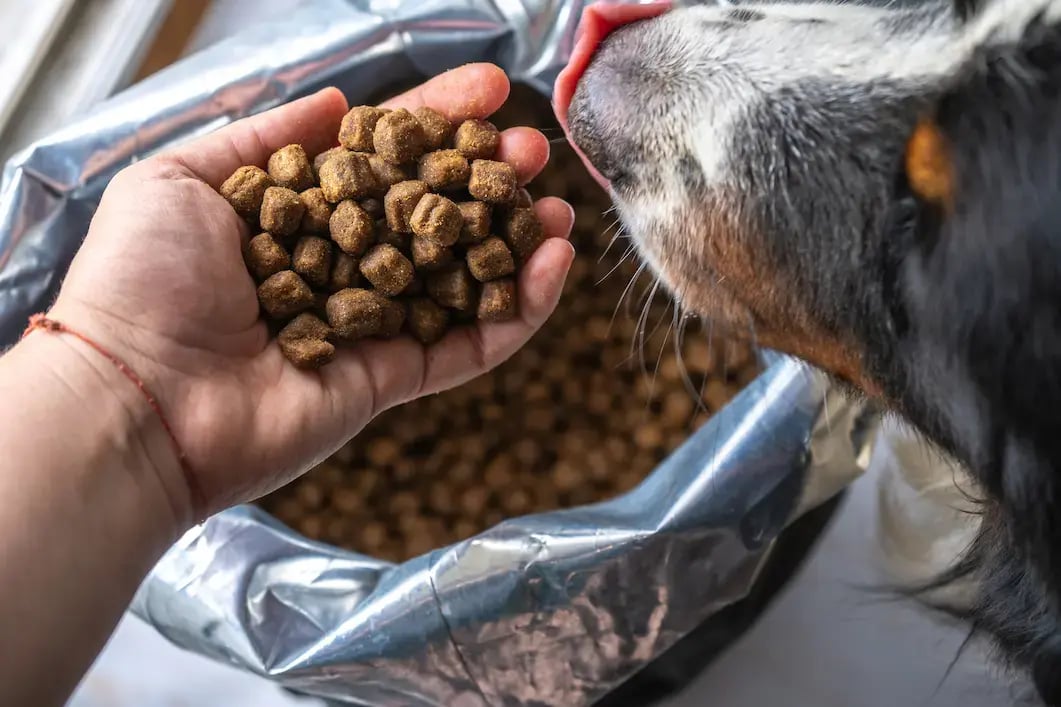
Dog licking a handful of dry kibble scooped from an open foil-lined pet food bag

Wash-Down & Hygienic Design

Pet food lines run from dry kibble to raw, frozen, and high-moisture. Equipment specs should match the sanitation requirements of the environment:


  • IP65 or higher enclosures — required wherever regular wash-down happens

  • Stainless on every product-contact and splash-zone surface, frames included

  • Sealed bearings, self-draining surfaces — no pooling, no product trapped out of reach

  • Open-frame design — inspect and clean without teardown

  • Tool-free disassembly enables proper cleaning of product-contact components

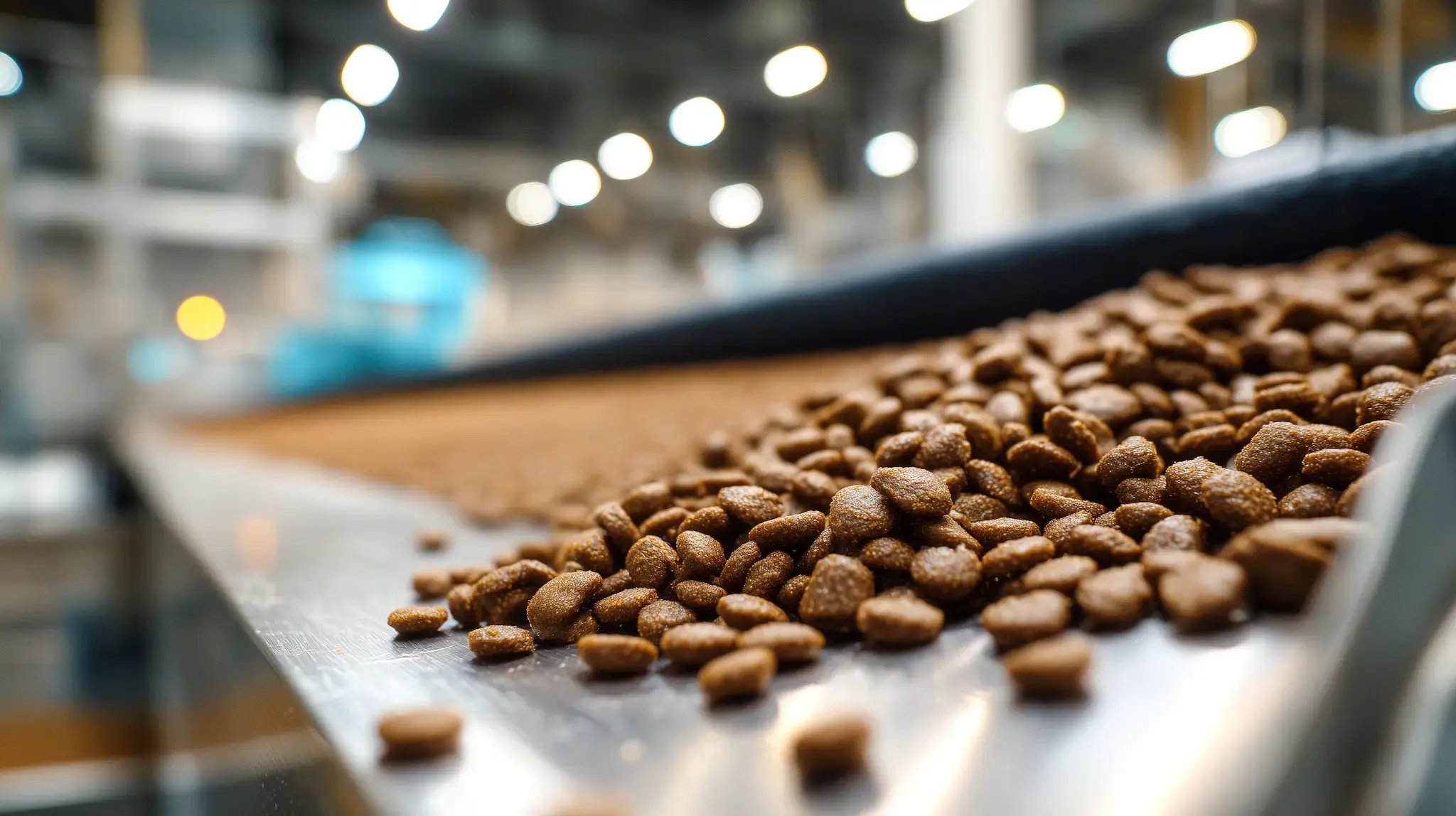
Dry pet food kibble moving along a stainless steel conveyor in a clean pet food processing facility
Viking Masek premade pouch machines are engineered for food manufacturing environments, built with stainless construction and Allen Bradley servo drives. Specific wash-down ratings should be confirmed for each application with the Viking Masek team.

QUESTIONS TO ASK ANY PACKAGING EQUIPMENT VENDOR

  1. What is the IP rating of the electrical enclosure?
  2. What grade of stainless steel is used on product-contact surfaces?
  3. Are bearings sealed and lubrication-free in product zones?
  4. How are product-contact components removed for cleaning? Are tools required?
  5. Does the machine design comply with PMMI Hygienic Design Guidelines or equivalent?
  6. What cleaning validation protocols have been tested on this machine?

Read Sanitation Standards in Pet Food Packaging Equipment

Learn More

ROI Framing: Throughput, Labor & Payback of Packaging Automation

Packaging automation is a capital investment, and the business case should be grounded in measurable outcomes rather than vague efficiency claims. Here’s how to frame the ROI for pet food packaging automation:

83a38d8b1fe014ef87b37648dad247cdb51b027a
Throughput Gains

The most direct financial driver is the gap between manual throughput and automated throughput, multiplied by the value of each additional unit produced.

A manual pet food bagging operation typically runs 8–12 bags per minute with 2–3 operators. A Simplex premade pouch machine runs 20–60 bags per minute with 1 operator. At the low end, that’s a doubling of throughput; at full speed, it’s a 300–500% throughput increase. Viking Masek customers have documented throughput increases of 300% or more after automating previously manual lines.

Labor Cost Offset

If a manual line requires three operators at $20/hour across two shifts, that’s $240,000+ in direct labor annually (before benefits). An automated line supervised by one operator reduces direct labor on that operation by 60–70%. The labor savings alone often pay back a portion of the machine cost within the first 2–3 years.

Waste Reduction

Manual filling creates variability in fill weight — typically ±5–10% per bag. Automated filling with a multihead scale or servo-driven auger tightens that variance to ±0.5–1%. On a product priced at $8/lb., overfill variance translates directly to eroded margin. Reducing overfill on a two million bag/year line from 5% to 1% recovers significant product cost annually.

Payback Period Benchmarks

Payback periods for pet food packaging automation vary by equipment and production volume, but manufacturers commonly see:

  • Simplex premade pouch machine: 18–36 month payback on a growing brand with labor savings plus throughput gains
  • Duplex or quadruplex equipment: Similar payback horizons at higher production volumes, driven primarily by cost-per-bag economics

The actual payback depends on your product margins, production volumes, labor costs, and current equipment situation. Viking Masek’s ROI Calculator is a useful starting point for building your business case.

Note: Viking Masek does not make financial guarantees. ROI outcomes depend on application-specific factors.

Read Packaging Automation ROI for Pet Food Manufacturers 

Learn More

Frequently Asked Questions

What is premade pouch packaging and how does it work for pet food?

Premade pouch packaging uses pre-formed bags manufactured by a film converter. At the packaging machine, a rotary turret picks each pouch, opens it, fills it with product (kibble, treats, supplements, etc.), and heat-seals the top. The result is a filled, sealed, shelf-ready bag, at rates of 20–60 bags per minute on a Simplex machine. This is the preferred format for premium pet food brands because of the flexibility of the format and the shelf appearance that premade pouches offer.

What types of pet food can be packaged in premade pouches?

Premade pouch machines handle a wide range of pet food formats: dry kibble, soft chews, biscuits, freeze-dried raw, meal toppers, powdered supplements, and liquid or semi-liquid products (with the appropriate fillers and spout-fitment options). The limiting factors are the compatibility of the fill head with the product’s characteristics (bulk density, particle size, flowability) and seal requirements.

What throughput can I expect from an automated pet food packaging line?

A Simplex premade pouch machine runs 20–60 bags per minute. A duplex runs 70-90 bags per minute combined); a quadruplex runs 80–240 bags per minute combined. By comparison, a manual pet food bagging operation typically runs 8–12 bags per minute. This means that automation can deliver a 200–500% throughput increase compared to manual operations.

How long does it take to change over a premade pouch machine to a different bag size?

Modern servo-driven premade pouch machines are designed for fast, tool-free changeover — typically 5-10 minutes for a bag size or format change with a trained operator. Older mechanical machines could require 1-2 hours of changeover for format switches.

What sanitation standards do pet food packaging machines need to meet?

Under FSMA’s Preventive Controls for Animal Food rule (21 CFR Part 507), packaging equipment must support your facility’s hazard analysis and preventive control requirements. This means stainless steel product-contact surfaces, IP65+ electrical enclosures for wet environments, sealed bearings, self-draining surfaces, and tool-free disassembly for cleaning. PMMI and 3-A standards are the industry’s go-to benchmarks for hygienic design.

How do I know if a premade pouch machine or a VFFS machine is right for my product?

The key factors are your shelf presentation requirements, format flexibility, and volume. If your brand competes on premium shelf presence and you run multiple bag formats or sizes, a premade pouch is typically the better fit. If you’re running a single, high-volume format where cost per bag is the primary driver, VFFS may offer better economics. See our side-by-side comparison guide [LINK TO CLUSTER PAGE 1] for a detailed breakdown.

What is the typical ROI timeline for pet food packaging automation?

Manufacturers commonly see payback in 18–20 months on Simplex premade pouch automation, driven by labor savings, throughput gains, and less product lost to overfilling. Actual results will depend on production volume, product margins, and current labor costs. Use Viking Masek’s ROI Calculator to model your specific situation.

What should I look for in a packaging equipment partner?

Look for a manufacturer with direct experience in pet food applications, not just general food manufacturing. Ask for references from pet food customers, request application-specific testing before purchase, and verify that the machine design meets your facility’s sanitation requirements. Service capability matters too: North American-based service and spare parts availability reduces downtime risk significantly.

Download Our packaging machine buyer's guide.

Whether you're completely new to this world or an old hand, the options can seem overwhelming, and you want to make the right decision. Understanding the types of machines available and knowing what questions to ask equipment manufacturers will help you make the best possible choice for your company.